
Living in Fairfax County means living with lots of Artificial Light at Night (ALAN) and Light Pollution. Light pollution is brightening of the night sky caused by streetlights and other man-made sources. Whether we realize it or not, ALAN and light pollution have a disruptive effect on our local ecosystems, the night sky and even our own health.
With over 1 million residents living in Fairfax County, there are many reasons why we keep lights on at night. Some do it for safety and security, some to play and some to see. There are business centers, industrial sites, buildings, sports fields, stadiums, streetlights and more that we all utilize at night. All these lights have different fixtures, bulbs, and illumination levels.
Fairfax County has worked to reduce the amount of light pollution we emit in Fairfax County. For example, streetlights in Chantilly have been upgraded to have shielded light fixtures and LED bulbs with less than 1400 lumens, which saves energy and directs the light only where it’s needed. But there are some ways you can help reduce light pollution as well.
What can be done to reduce light pollution?
Light pollution is one of the easiest environmental issues to solve. Some simple actions include turning off your lights at night if they’re not needed, adding timers and changing to lower-intensity light bulbs. Ask yourself these three questions first:
- Is the light useful?
- Does it have a clear purpose?
- Are you using those lights only when and where they are needed?
Once those questions are answered, we can start to make sure that we’re using the light that is needed in the best possible way.
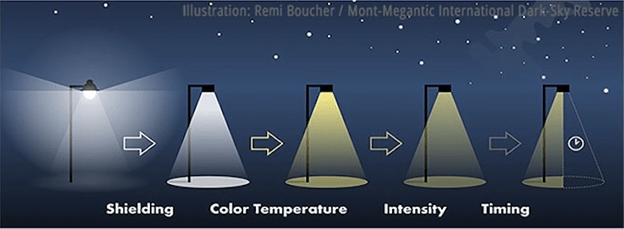
- Is your light shielded or aimed in a way, so it faces downward, only where it’s useful? Shielded light fixtures have a “cap” on top of a fixture, so that the bulbs shine downward, rather than up and around. This reduces energy costs and directs the light only where it’s useful.
- Is it low level? Lights should be no brighter than necessary to save money and reduce glare. Any lights under 1,500 lumens are considered within county ordinances.
- Is it controlled? Light should only be on when needed. Use timers and motion sensors to control when your lights are on without having to flip a switch!
- Is it warm colored? Warm colored light travels less far and is better for our health. Use amber tone lights whenever possible, listed as less than 2700K on the bulb box.
We’d like to hear about your efforts to help benefit our natural areas within the boundaries of your own property! If you are doing things on your property to help make your lights more dark-sky-friendly, please tell us about it by sharing your experience on our Watch the Green Grow website. By doing so, you can be part of our countywide community effort to “Watch the Green Grow” within our communities.
For more information about light pollution and lighting design on our dark skies website https://www.fairfaxcounty.gov/parks/topics/dark-skies.
Additional Resources:
- Are you interested in participating in citizen science regarding light pollution? Visit the Globe at Night website https://globeatnight.org/. Globe at Night is an international citizen-science campaign to raise public awareness of the impact of light pollution by inviting citizen-scientists to measure & submit their night sky brightness observations.
- Visit the Dark Sky International Association’s website here https://darksky.org/ . Dark Sky International restores the nighttime environment and protects communities from the harmful effects of light pollution through outreach, advocacy, and conservation. Virginia’s local chapter is called DarkSky NOVA.
 Our Stories and Perspectives