
Huntley Meadows Park is widely known throughout the region for its abundant wildlife and is a choice destination for birding every year. With its strategic location and prime natural resources, Huntley Meadows often helps play an important role in wildlife research and conservation. In 2024, the Fairfax County Park Authority joined thousands of locations across 34 countries in the world’s largest international wildlife tracking research network collaboration – the Motus project.

Created by Birds Canada in 2014, the Motus Project (motus is Latin for “movement”) brings together organizations and individuals to facilitate research and education on the ecology and conservation of flying migratory species. This wildlife tracking network includes over 1,500 Motus receiver antenna stations which detect transmitters attached to migrating wildlife. Researchers have used the MOTUS network to track and understand migration routes, breeding habitat and wintering grounds for dozens of bird species across North America and the entire western hemisphere.
The information obtained through research studies such as this is critical to understanding, protecting and preserving the amazing wildlife that we enjoy in Fairfax County – whether they live in the county all year long or are just passing through.
Huntley Meadow Park’s journey to the Motus Project began in 2021 with our participation with the New Hampshire Audubon Society to study the preferred breeding and wintering habitat of the Rusty Blackbird. in the last 40 years, rusty blackbirds have lost between 85% and 95% of their population (American Bird Conservancy). Due to the large data gap in data southeast of the Potomac River and Chesapeake Bay, Huntley Meadows was selected to help researchers understand if rusty blackbirds from the Northeast were wintering at Huntley or nearby. Birders at Huntley see rusty blackbirds every winter, the park has hundreds of acres of wet forests, a preferred feeding habitat for Rusty Blackbirds.
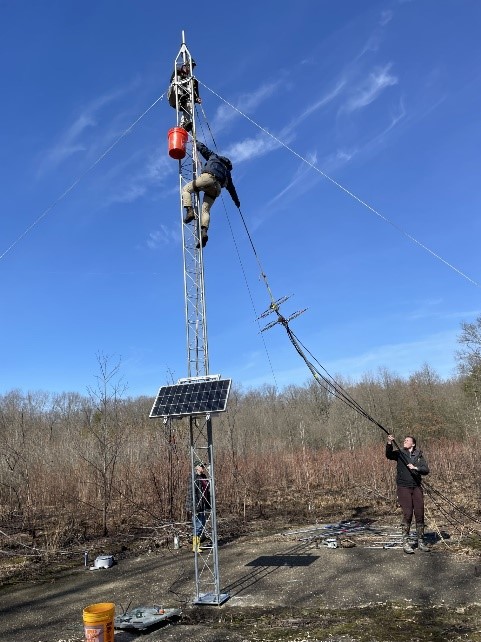
Now, with the new Motus Project antennae installed at Huntley Meadows, the station will receive valuable data from any bird fitted with a transmitter flying within approximately 20 kilometers of the station (depending on the frequency of the transmitter). While the project primarily focuses on birds, the station will also be able to track other migratory species with transmitters including bats, butterflies and dragonflies.
On March 31, the Huntley station detected its fist bird, an American Robin. You can see this particular robin’s movements over the last 22 months – a path stretching from Virginia to New Brunswick, Canada – on the Motus Wildlife Tracking System. This and all future tracking data acquired from the park will be made available on the project website at www.motus.org.
Fairfax County is home to a robust variety of wildlife which lives within the more than 24,000 acres of parkland owned by the Fairfax County Park Authority. Better understanding their movements and habitat is vital to their conservation. The Fairfax County Park Authority would like to thank Carol Foss, Birds Canada, the Audubon Society and The American Bird Conservancy for collaborating and funding the station installation.
Contributed by: Dave Lawlor, Ecologist, Fairfax County Park Authority
 Our Stories and Perspectives