
By Brooke Ehmann-Jones
“Species have the potential to sink or save the ecosystem,”
Douglas Tallamy, American Ecologist and Conservationist
Many people may not realize that what they plant in their lawns and gardens shapes our overall ecosystem. An emphasis on introduced trees, shrubs, flowers, and lawns that look and smell good may have been sustainable in the 20th century, but with increasing development impacting natural areas, plants native to this area are disappearing and invasive plants are taking over.
This decline in the native plant ecosystem is also helping to fuel a decrease in insects that have evolved to survive only on specific native plants, which is in turn fueling a reduction in birds and other wildlife that depend on insects. Hence, focusing on what species we plant in our yards, schools, and community areas is incredibly important to our overall ecosystem.

My name is Brooke Ehmann-Jones, I am a Freshman at Justice High School and a member of the 2022-2023 Northern Virginia Soil and Water Conservation District Youth Conservation Leadership Institute. I wanted to design a native plant garden in an area overrun by invasive plants at the park next to my high school. The area had once been a meadow, but when the school constructed a new addition nearly a decade ago, using the site for construction staging, the meadow was disturbed and invasive species such as Porcelain Berry, Japanese Honeysuckle, and English Ivy took over.
It took volunteers three years of dedicated labor to remove the invasive vines and digging out roots. Once the area was cleared, I began my project to create a native plant meadow and bring the area back to life. I started by analyzing several varying factors such as soil moisture, slope, and sun exposure. I also researched plants native to Fairfax County suitable for the park conditions that would provide the most ecological benefits.

With the help of Matt Bright, the Executive Director at Earth Sangha, I designed five garden plots. Each had a foundation set of six plant species spaced consistently throughout each plot and four differentiated “specialized” species that thrive in the specific soil and sun conditions. I also made a control plot to see what native plants might express themselves from the underlying seed bank once the invasives were removed.
I chose pollinator-friendly species to increase populations of bees, butterflies, and birds, as well as to create a beautiful landscape. Each plot was designed to be densely planted, with deer-resistant natives for the plot edges. This close planting ensures invasives cannot penetrate the plots. Each plot, about eight feet in diameter, was cleared with a two-foot buffer area to discourage invasives from spreading. We also caged each plot with four-foot wire fencing to prevent deer from eating the plants before they become established. With continued maintenance, these plots will eventually be able to spread throughout the meadow until all invasive species are pushed out.
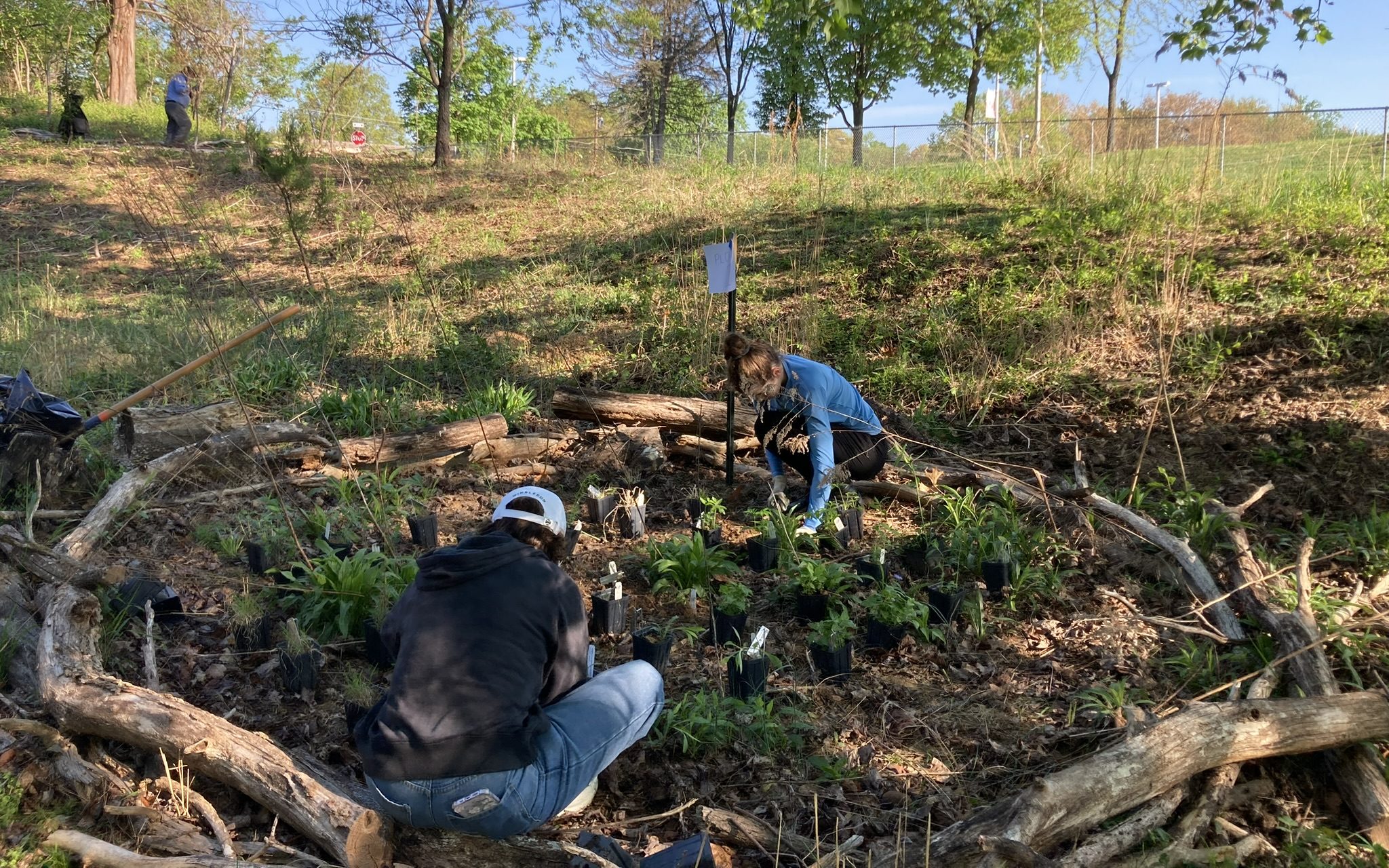
My native plant meadow project is a long-term effort, but just removing the invasives alone had a very quick and visible impact on the park. Planting native plants in your yard or school is something that you can do in the short term that has positive results for the plants and wildlife that depend on them. You can turn an invasive-filled area into a thriving native habitat, as I did, or create a seed bank for wildlife in your yard.
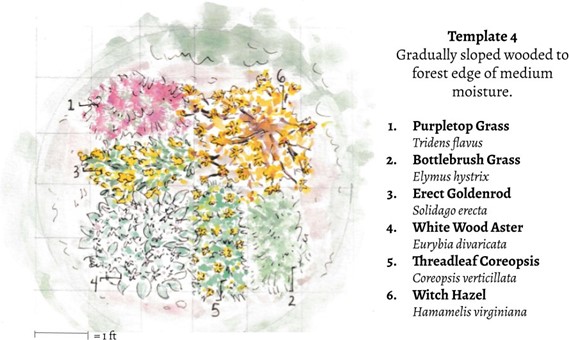
If you want to plant native plants in your yard the task can feel daunting because Fairfax County is home to over 1200 native plant species. The guide that I created provides people with a starting point of some key foundational plants that should thrive in our local yards, gardens, and community spaces.
Build your own native plant garden (Fairfax County, VA):
- Choose a spot, keep in mind factors such as soil moisture, sunlight exposure, and slope when choosing plants. Each template has two grasses, three flowering plants, and one shrub to build an ecosystem.
- Clear an area of about six feet in diameter of all invasive plants. Use these resources to identify invasives: VA DCR Virginia Invasive Plant Species List, Invasive.org Plant Species List , Invasive Plant Atlas of the United States.
- Choose a template that best fits the sun, moisture, and slope of your area. Plant herbaceous plants 12-18 inches apart, and shrubs with a little more room of three feet on center.
- Once plants are planted, mark each plant with a labeled marker to ensure no confusion between planted plants and pop-up species in the future.
- Place four-foot-tall metal caging around the plot with three five-foot-tall posts to prevent deer browse. Use at least 25 feet of caging for each plot so that you can have extra caging for an entrance that you can pull open for plot maintenance.
- Ideally, water the plants the day of planting, then let nature do the rest of the work. Keep an eye on the plot and weed when necessary.
- When sourcing plants specifically ask for the Latin genus and species name because there can be multiple types of the common name. You can find the plants at Earth Sangha, a local non-profit native plant nursery.


 Our Stories and Perspectives